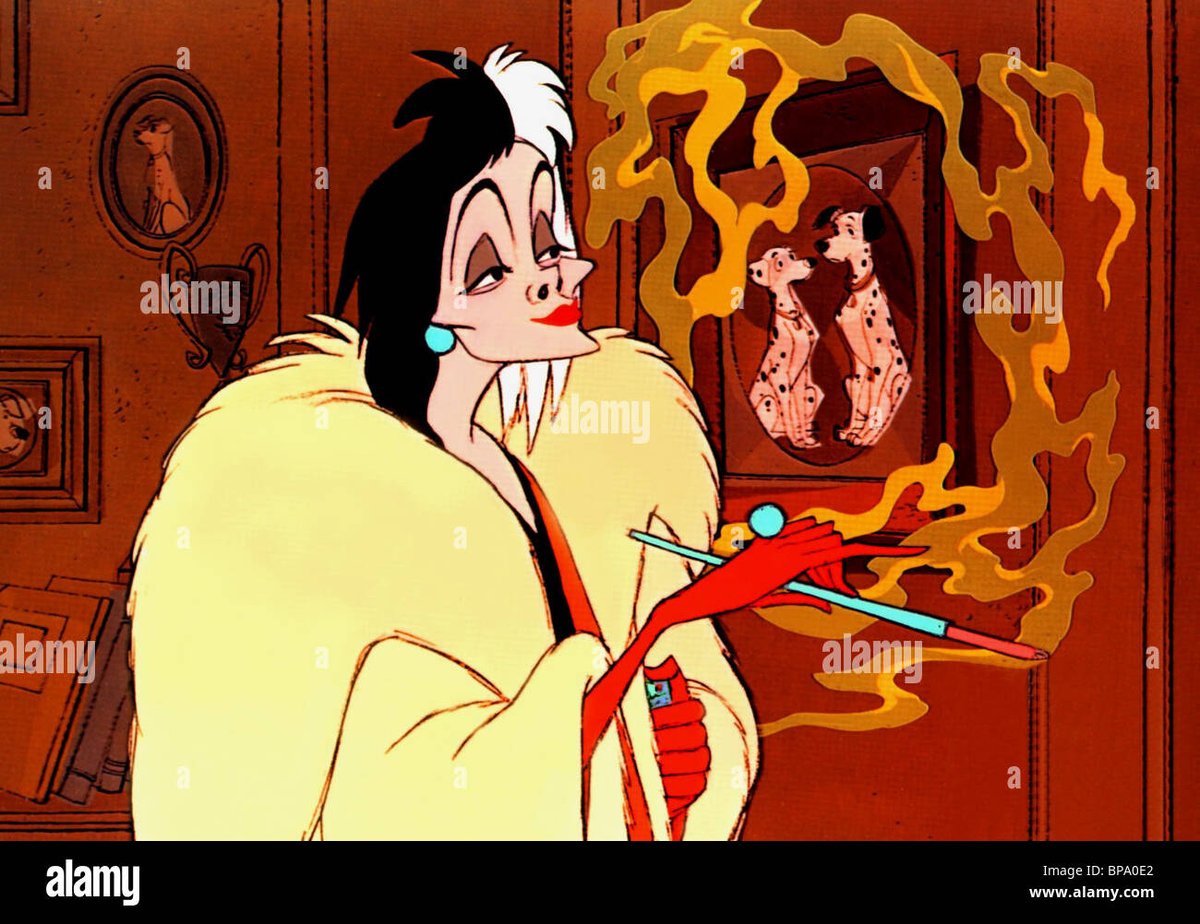
From the pages of a beloved novel to the dazzling spectacle of the silver screen, Cruella de Vil has etched herself into the annals of pop culture history as the quintessential villain. She's more than just an antagonist; she's a symbol of unchecked vanity, relentless greed, and a chilling disregard for the innocent. Her very name, a sinister play on "cruel" and "devil," perfectly encapsulates the malevolent spirit that has captivated audiences for decades.
This Super Pillar Hub article invites you to journey through the many facets of Cruella's existence, exploring her evolution from a wealthy, fur-obsessed socialite to a complex, even sympathetic, anti-hero. We'll delve into the artistry and storytelling that brought her to life, dissecting her iconic style, twisted motivations, and enduring legacy across every major adaptation. Prepare to be drawn into the dark allure of one of Disney's most unforgettable characters.
Cruella's Literary Beginnings: A Sinister Heiress
Our first encounter with Cruella de Vil traces back to Dodie Smith's 1956 novel, The Hundred and One Dalmatians. Here, she is introduced as a fabulously wealthy London heiress, a "notorious" figure with a lavish lifestyle and an insatiable desire for furs. Smith paints a vivid picture of a woman draped in white mink, driving a distinctive black-and-white striped Rolls Royce Silver Wraith, always complaining of the cold despite roaring fires in her home. Her marriage to a subservient furrier and her peculiar diet of pepper-flavored food further underscore her eccentric and unsettling nature.
Cruella's sinister interest in the Dearlys' Dalmatians quickly escalates from offering to drown newborn puppies to orchestrating the theft of 99 pups for a nefarious purpose. This original blueprint established her core traits: an obsession with fur, immense wealth, and a chilling cruelty. The novel even chronicles her downfall, as the Dalmatians and her abused Persian cat destroy her husband's fur stock, forcing the De Vils into debt and a bizarre switch to metallic plastics, a shock that literally changes her hair color. To understand how these initial ideas blossomed into the villain we know, Explore Cruellas origin and evolution through her various interpretations.
Animating the De Vil: Disney's Cartoons Bring Her to Life
When Disney adapted One Hundred and One Dalmatians into an animated feature in 1961, Cruella de Vil truly exploded into the global consciousness. Voiced by Betty Lou Gerson and animated by the legendary Marc Davis, this version introduced a "crazed mania" that became her signature. The animated Cruella, with her skeletal frame, wild expressions, and distinctive red-and-black Zimmer-like car, cemented her as a pop culture icon, earning her a spot on AFI's list of greatest villains. Here, her cat and husband are notably absent, streamlining her focus purely on the Dalmatians and her bumbling henchmen, Jasper and Horace Badun. This iteration perfectly captured her singular obsession and propelled her into legend, inspiring Roger Radcliffe's unforgettable song, "Cruella De Vil."
Evolutionary Animated Appearances
Cruella's animated journey didn't end with the 1961 classic. In 101 Dalmatians II: Patch's London Adventure (2003), voiced by Susanne Blakeslee, we see her released from jail, attempting art therapy with the meek painter Lars, only for her fur obsession to reignite with horrifying intensity. She descends into complete insanity during the final chase, ultimately being sent to a mental institute. The animated 101 Dalmatians: The Series offered a slightly different take, with April Winchell voicing a more sane but temperamental Cruella, whose main goal often involved stealing the Dearlys' farm for her formidable mother, Malevola. This version explored her childhood desire for a Dalmatian and delved into corporate villainy, showcasing a Cruella who was evil but perhaps more calculating.
Later, she became a recurring menace in Disney's House of Mouse, always inspecting dogs with a ruler, and made appearances in Mickey's House of Villains. Most recently, in 101 Dalmatian Street (set 60 years after the original), Michelle Gomez voiced an elderly Cruella, still scheming for Dalmatian fur, now aided by her great-nephew Hunter de Vil. These varied animated portrayals consistently highlight her core drive, but with nuanced differences. To truly understand the engine behind her schemes and fashion, What drives Cruella across these distinct animated worlds. Ultimately, her continued presence in these animations highlights Uncover Cruellas role and impact on the entire franchise narrative.
Live-Action Incarnations: From Classic Villain to Origin Story
The transition to live-action brought Cruella de Vil to breathtaking, terrifying life, most notably with Glenn Close's mesmerizing portrayals. In the 1996 film 101 Dalmatians, Close delivered a vindictive and utterly captivating performance as the magnate of the "House of DeVil," specializing in fur couture. Her elaborate costumes, complete with claws and teeth necklaces, visually amplified Cruella's inner evil. This film solidified her as a fashion-forward villain, with her pursuit of puppy fur driven by its "superior softness" for a new collection.
Close returned in 102 Dalmatians (2000), where Cruella, initially "cured" by hypnotherapy and calling herself "Ella," devoted herself to animal welfare. However, the chiming of Big Ben dramatically reversed her conditioning, reigniting her obsession for 102 puppies. This sequel showcased the inherent evil lurking beneath the surface, revealing that even science couldn't fully suppress her villainous nature. She partnered with the equally flamboyant French furrier Jean Pierre Le Pelt, culminating in a deliciously theatrical downfall.
A New Chapter: The Origin Story and Beyond
Perhaps the most significant recent live-action adaptation is 2021's Cruella, starring Emma Stone. This origin story reimagined Cruella as Estella Miller, a young, ambitious fashion designer whose traumatic past shapes her transformation into the villainous persona. Here, her iconic black-and-white hair and love for dramatic fashion are given a detailed backstory, as she wages a sartorial war against Baroness von Hellman, who is ultimately revealed as her biological mother. This film offered a more complex, almost anti-heroic Cruella, exploring themes of identity, revenge, and the blurred lines between good and evil.
Beyond Disney's direct adaptations, Cruella has made memorable appearances in other live-action fantasy series. Victoria Smurfit's portrayal in ABC's Once Upon a Time depicted her as a sociopathic witch with the power to control animals, whose tragic backstory was intertwined with "The Author" Isaac. In Descendants (2015), Wendy Raquel Robinson presented Cruella as a neglectful and abusive mother to Carlos, instilling in him a deep fear of dogs. These diverse interpretations offer a rich tapestry of her character, prompting us to ask: how do these different portrayals compare and contrast? To dive deeper into these variations, Comparative Analysis of Cruella Across every version reveals fascinating insights into her enduring appeal.
Beyond the Screen: Games, Books, and Cultural Echoes
Cruella's influence extends far beyond film and television. She has terrorized players in video games like 101 Dalmatians: Escape from DeVil Manor and 102 Dalmatians: Puppies to the Rescue, where her schemes range from torturing animals in her youth to turning abducted pets into plush toys. Her cunning and understanding of the modern world even earned her a spot as an "Overtaker" villain in the Kingdom Keepers book series. In Evil Thing: A Tale of that De Vil Woman, her first-person autobiography provides a chilling descent into madness, driven by personal loss and the mysterious power of jade earrings.
Her distinctive look and malevolent charm have also left an indelible mark on popular culture. Cruella has been referenced in songs by artists like Queen and Children 18:3, and her iconic theme song has been covered by Selena Gomez and Dr. John. Fashion designers and celebrities, from Lady Gaga to Melanie Martinez, have drawn inspiration from her dramatic black-and-white aesthetic and audacious style. Even satirical media has embraced her, with parodies appearing in The Simpsons (Mr. Burns' "Two Dozen and One Greyhounds"), Rugrats in Paris, and various sketch comedy shows. From an inflatable depiction at the 2012 London Olympics Opening Ceremony to countless Halloween costumes, Cruella de Vil remains a powerful cultural touchstone. Her bold choices in attire are a constant source of fascination; if you're curious about the impact of her signature look, Uncover Cruellas iconic style and how it has shaped fashion.
The Enduring Legacy of a Fashionably Evil Icon
Cruella de Vil's journey from a chilling literary character to a multifaceted pop culture icon is a testament to the power of compelling villainy. She embodies our fascination with the dark side of humanity, a creature driven by extreme desires and an almost artistic commitment to her own brand of evil. Each adaptation, whether animated, live-action, or literary, has added new layers to her persona, making her a character ripe for continuous reinterpretation and exploration.
As storytellers continue to delve into her past, motivations, and impact, Cruella de Vil remains a captivating figure. She reminds us that sometimes, the most memorable characters are those who dare to be truly, fabulously, and utterly wicked. Her legacy is not just one of villainy, but one of enduring cultural significance, ensuring that she will continue to inspire, terrify, and entertain for generations to come.